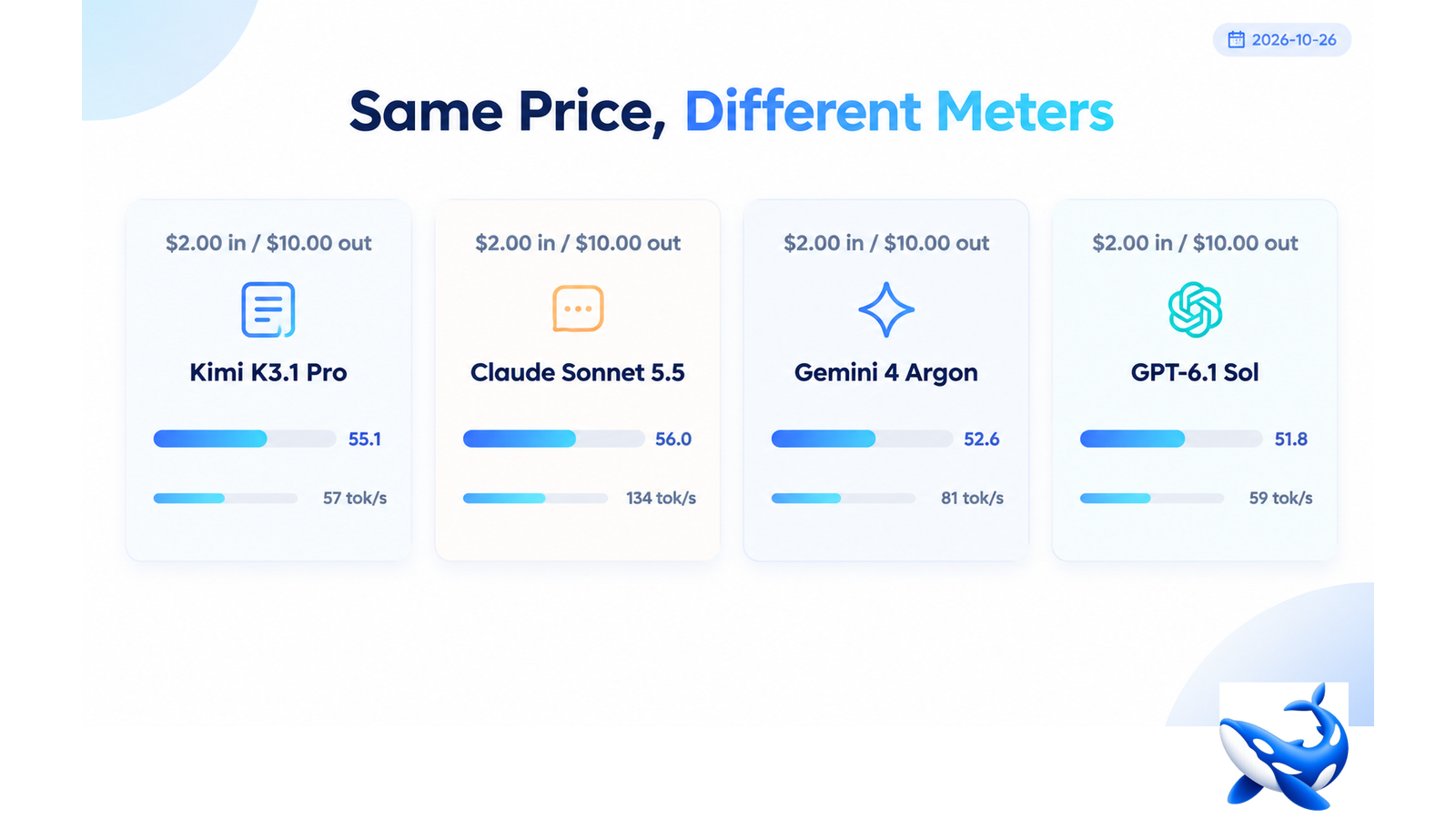

Four frontier-class models now bill at exactly $2.00 per million input tokens and $10.00 per million output tokens: Kimi K3.1 Pro, Claude Sonnet 5.5, Gemini 4 Argon and GPT-6.1 Sol. On the independent index they score 55.09, 56.00, 52.56 and 51.83 — a 4.17-point spread — and they differ by more than two to one on output speed [INDEPENDENT, 26 October]. On OrcaRouter the Kimi K3.1 Pro pricing lines match that card exactly, passed through at list with no markup, so the table below is a comparison you can act on with a single key and no new contract.
That is a rare moment in this market. For two years, price was a proxy for capability: the expensive card was the good model. A shared $2/$10 card breaks the proxy, and what replaces it is a set of second-order differences — speed, cache pricing, component scores — that most comparisons do not put side by side.
The four, on every row that differs
| Kimi K3.1 Pro | Claude Sonnet 5.5 | Gemini 4 Argon | GPT-6.1 Sol | |
| AA Intelligence Index | 55.09 | 56.00 | 52.56 | 51.83 |
| Input / output /1M | $2.00 / $10.00 | $2.00 / $10.00 | $2.00 / $10.00 | $2.00 / $10.00 |
| Cache read /1M | $0.20 | $0.10 | $0.10 | $0.10 |
| Output speed (AA) | 57.5 tok/s | 134.2 tok/s | 80.8 tok/s | 58.8 tok/s |
| Context | 1M | 1M | 1M | 1M |
| Terminal-Bench 4.0 | 67.17% | 63.64% | 57.07% | 56.06% |
| Humanity’s Last Exam | 52.46% | 54.96% | 57.09% | 52.92% |
| Long-context recall | 86.33% | 82.67% | 79.67% | 83.00% |
| AA-Omniscience | 29.52 | 32.30 | 42.35 | 41.53 |
Every row is a purchase decision hiding in a table.
What the price line no longer tells you
Cache read is where the four actually differ on money. Three of them charge $0.10 per million cached tokens; Kimi K3.1 Pro charges $0.20. On a workload with a long stable prefix that is read repeatedly, caching carries half the bill — so the double-rate cache read wipes out a meaningful share of the headline parity. If your traffic is a million-token document read twenty times, Sonnet 5.5 costs less than Kimi K3.1 Pro on caching alone before any capability argument starts. If your traffic is short prompts and long answers, the cache line barely appears and the parity is real.
Speed is the widest gap and the least discussed. Sonnet 5.5 runs at 134.2 output tokens per second on AA’s provider, more than twice Kimi K3.1 Pro’s 57.5. For a batch pipeline that is a throughput difference you can put a number on. For an interactive coding agent it is the difference between a model that feels responsive and one that feels deliberate: at 134 tok/s a 2,000-token answer streams in about fifteen seconds; at 57.5 it takes thirty-five.
The component scores split along a clean line. Kimi K3.1 Pro wins the agentic and recall rows — Terminal-Bench, long-context recall — and loses the knowledge rows to both Gemini 4 Argon and GPT-6.1 Sol. Argon’s omniscience score of 42.35 is 12.8 points above Kimi’s, with an HLE of 57.09% against 52.46%. If your workload is a question about the world rather than a task over your own data, the shared price card is not the deciding row.
See also: Cross Trainer Sneakers for Men Who Want Less Fuss Between Different Training Styles
Why the shared card happened
Three forces, none of them generosity.
Serving costs converged. All four are 1M-context models with aggressive caching and similar serving stacks. Once the cost to serve a token is comparable, the price converges, and $2/$10 has become the visible clearing price for the tier below the true flagships.
The flagships moved up. Opus 5.5 bills $4.00/$20.00 and blends to $8.00; GPT-6 Astra and Claude Fable 5.1 bill $10.00/$50.00 and blend to $20.00 [INDEPENDENT]. The $2/$10 card is the tier that used to be called frontier and is now called “the good workhorse”.
Anchoring works. A model that scores 55 at $2/$10 makes a model that scores 57.6 at $4/$20 look expensive, which is precisely the argument Kimi’s launch is making. The other three vendors are on the same card for their own reasons, and the result is that a buyer can now choose on fit rather than budget.
What differs is how many tokens each model needs to finish the same answer, and that is the variable a rate card cannot show. Two models quoting $10.00 per million output can differ by 40% on the cost of a finished answer if one writes 40% more, and this model writes a lot: 55,195 output tokens per Intelligence Index task, 63% of them reasoning [INDEPENDENT]. The shared card is a shared starting point, not a shared bill.
Choosing inside the card
A decision procedure that takes ten minutes:
Write down your output-to-input ratio. At 1:10, caching dominates and the cache-read line decides between Kimi and the other three. At 1:1, the output line dominates and the card is genuinely flat.
Write down your latency requirement. If a human waits on the stream, 57.5 tok/s is inside the range where a long answer feels slow; 134 is not. If nothing waits, ignore the row.
Write down whether the answer needs knowledge or instructions. Knowledge-leaning work — factual recall, citation, domain questions with short prompts — favours Argon or Sol on the omniscience row. Instruction-leaning and agentic work favours Kimi on Terminal-Bench and long-context recall.
Then run twenty real tasks through two candidates. The card is flat, so the only differences that count are the ones your traffic exposes, and no benchmark table can do that for you. Route the two through one key, split the traffic, and compare cost per completed task rather than per token — that last metric is where the shared price card stops being flat.
The row that will change first
Prices on this card are not stable. Kimi K3.1 Pro already cut a third off its own predecessor’s rates in a single release, and Moonshot has a second SKU at $4/$20 for doubled speed [VENDOR]. If the Highspeed tier becomes the default way this model is sold — which is how the consumer product already positions speed — then the “same card” comparison quietly becomes a comparison of a $2/$10 tier against a $4/$20 tier, and the honest table changes shape.
Until then, the four-way tie is real and it is good news: it means the cheapest way to improve your stack this quarter may be a routing decision rather than a model purchase. Add a second model on the same card, measure cost per finished task, and let the traffic decide. Re-run the table whenever one of the four vendors changes its card, and treat today’s tie as a snapshot of four pricing strategies rather than a law of the market.
Sourcing note: every index score, component score, speed, cache price and context window is Artificial Analysis on index v4.3.2, read 26 October 2026. The $2.00/$10.00 rate cards are each vendor’s published list price and match what our catalogue passes through without markup. The Highspeed SKU is Moonshot’s and is not carried on our route. The token-ratio reasoning and the “cost per completed task” recommendation are ours.